Unifying Hexagonal Architecture and Domain-Driven Design
Introduction: The Software Complexity Problem
A persistent challenge in enterprise software architecture is the gradual entanglement of core business logic with external infrastructure, such as user interface components and database persistence mechanisms. When presentation details or database dependencies infiltrate business logic, applications become fragile, difficult to test, expensive to maintain, and resistant to organizational change. Over time, technical debt accumulates, transforming once-promising systems into brittle monoliths where a change in a database schema breaks business workflows or a UI upgrade forces sweeping refactoring across application layers.
To arrest this structural decay, enterprise architects can combine two complementary architectural paradigms: Alistair Cockburn’s Hexagonal Architecture (also known as Ports and Adapters) and Eric Evans’ Domain-Driven Design (DDD).
While Domain-Driven Design offers a rigorous modeling discipline for structuring complex business logic inside a system, Hexagonal Architecture provides the explicit structural boundary needed to isolate that logic from external technologies. Combined, they establish a cohesive architectural blueprint that protects core business assets, prevents framework lock-in, and guarantees long-term maintainability for complex enterprise systems.
Deep Dive: Core Concepts of Hexagonal Architecture (Ports & Adapters)
Origin and Primary Intent
Formulated by Alistair Cockburn (initially discussed on the Portland Pattern Repository wiki and formally published as “Ports and Adapters”, HaT Technical Report 2005.02), Hexagonal Architecture was designed to eliminate classic structural pitfalls in object-oriented software design. Its primary intent is to allow an application to be driven equally by human users, automated test suites, batch scripts, or other programs, while remaining completely decoupled from runtime devices, databases, and external services.
By enforcing a hard application boundary, Hexagonal Architecture enables “headless” execution—allowing comprehensive automated regression suites to run rapidly in isolation without requiring active user interfaces or live database connections.
Key Architectural Shift: Inside-Outside Asymmetry Traditional application architecture relies on a one-dimensional “Top-Bottom” or “Left-Right” layered stack (e.g., UI → Business Logic → Database). Hexagonal Architecture replaces this mindset with an Inside-Outside Asymmetry. The fundamental architectural rule is that code residing on the inside (the application core) must never know about, leak into, or depend on external technologies residing on the outside.
Core Components: Application Core, Ports, and Adapters
Hexagonal Architecture divides the software system into three structural components:
- Application Core (Inner Hexagon)
The isolated center containing application use cases, domain rules, and business workflows. It is completely ignorant of external input/output devices and technical delivery mechanisms. - Ports
Abstract, purposeful conversation APIs (interfaces) that define interaction protocols between the application core and the outside world. Ports are categorized into two types:- Primary (Driving) Ports: Located on the left or top side of the hexagon, these ports define how external actors (GUIs, HTTP clients, test harnesses, batch drivers) trigger and drive the application core.
- Secondary (Driven) Ports: Located on the right or bottom side of the hexagon, these ports define how the application triggers external dependencies (databases, messaging systems, notification services) to retrieve data or send outbound events.
- Adapters
Technology-specific glue code that maps external protocols to abstract ports. An adapter translates external signals (such as an HTTP POST request or a GUI button click) into a procedure call expected by a primary port, or translates an abstract secondary port request into concrete database queries (such as SQL) or flat file operations.
| Component Name | Architectural Role | Concrete Source Examples |
|---|---|---|
| Application Core | Encapsulates application use cases and domain logic in complete isolation from runtime technologies. | Discounter application class |
| Primary (Driving) Ports & Adapters | Interfaces and adapters that receive external events/inputs and drive the application core. | FIT ColumnFixture (TestDiscounter), GUI ActionListeners, Batch drivers, HTTP controllers |
| Secondary (Driven) Ports & Adapters | Interfaces and adapters that are invoked by the application core to interact with infrastructure. | RateRepository (Port interface), MockRateRepository (Adapter), SQL database adapters, Flat file adapters |
Operational Advantages
Designing strictly to the application boundary yields significant operational advantages. By replacing external infrastructure with lightweight test adapters (such as in-memory mock databases or automated test frameworks like FIT/FitNesse), development teams can execute comprehensive automated regression suites instantly.
This rapid feedback loop prevents business logic leaks into presentation layers and shields enterprise applications from premature framework obsolescence. As Cockburn defined the pattern’s core intent:
“Create your application to work without either a UI or a database so you can run automated regression-tests against the application, work when the database becomes unavailable, and link applications together without any user involvement.”
Deep Dive: Core Concepts of Domain-Driven Design (DDD)
Premise and Strategic Design
Introduced by Eric Evans in 2004, Domain-Driven Design flows from the premise that the heart of complex software development lies in deep knowledge of the specific business domain. Strategic DDD focuses on two primary pillars:
- Ubiquitous Language
A rigorous, shared vocabulary built directly around the domain model.
It is used identically by technical developers and business domain experts across all verbal communication, specification documents, and directly within the codebase. - Bounded Context An explicit conceptual and physical boundary (encompassing team organization, specific application sections, codebases, and database schemas) within which a specific domain model and its Ubiquitous Language strictly apply.
Operational Benefits of Ubiquitous Language within a Bounded Context:
- Less Risk of Miscommunication
Eliminates the need for translation layers between business jargon and developer terminology. - Faster and More Efficient Interaction
Enables developers and domain experts to analyze requirements and adapt models rapidly. - Cohesive Codebases Business domain knowledge resides directly inside the software structure rather than in external documentation.
- Improved Maintainability and Extensibility Source code written in the Ubiquitous Language makes systemic intent transparent, simplifying long-term evolution.
Tactical Building Blocks (The Evans Classification)
To model domain logic inside a Bounded Context, Evans established a taxonomy of domain constructs:
- Entities
Objects defined by a continuous thread of identity that runs through time and across distinct representations, rather than by their attributes. Identity in DDD is a business construct (e.g., customerID), not an object-oriented memory reference. - Value Objects
Immutable objects that describe characteristics or attributes of a domain concept without possessing conceptual identity. Equality is determined strictly by comparing attribute values. - Services
Standalone operations or processes within the domain model that represent domain verbs or activities that do not naturally belong inside an Entity or Value Object.
The Domain Service Statefulness
The Domain Service Statefulness is an architectural nuance…
While early DDD literature advocated for strictly stateless domain services, Martin Fowler’s analysis of the Evans Classification highlights an important nuance: while stateless services are preferred to simplify concurrency and scaling, absolute statelessness is not an immutable requirement if the domain operation demands contextual state—provided that state management is safely encapsulated within the execution context.
Tactical Rules for Domain Associations and Traversal
Unconstrained associations between domain elements degrade maintainability and increase cognitive load. To keep domain models decoupled and maintainable, architects must enforce three tactical association rules:
- Prefer Unidirectional Traversal: Restrict associations to a single traversal direction wherever possible rather than maintaining bidirectional references.
- Apply Qualifiers to Reduce Multiplicity: Use qualifying keys (e.g., indexing an association by a unique identifier) to minimize 1-to-N or N-to-M multiplicity down to 1-to-1 lookups.
- Eliminate Unnecessary Associations: Remove associations that are not essential to fulfilling core domain invariants or use cases.
Comparative Analysis: Entities vs. Value Objects
- Identity
- Entity
Defined by a unique, persistent identity that survives state changes (e.g., a specific Customer or Airline Seat). - Value Object
Lacks conceptual identity; matters strictly as a combination of its attributes (e.g., Date, Money, Color).
- Entity
- Mutability
- Entity
Mutable; state and attributes evolve over time while maintaining the same core identity. - Value Object
Immutable; state cannot be modified after creation. To alter a value, the existing instance is replaced with a new instance.
- Entity
- Equality Definition
- Entity
Evaluated strictly by identity comparisons regardless of current attribute state. - Value Object
Evaluated by overriding equality and hash methods to compare every attribute value.
- Entity
Object Lifecycle & Domain Layers
Managing complex domain objects throughout their lifecycle requires specialized tactical patterns:
- Aggregates
Clusters of associated domain objects (Entities and Value Objects) that are treated as a single cohesive unit for data changes. Every Aggregate defines a explicit boundary and is managed by an Aggregate Root (a specific Entity). External objects may only hold references to the Aggregate Root, ensuring that all business invariants inside the Aggregate boundary are strictly enforced during state modifications. - Factories
Encapsulate the creation of complex domain objects or Aggregates, ensuring that valid invariants and initial states are established upon instantiation. - Repositories
Encapsulate object retrieval and storage mechanisms, providing the domain layer with an interface that mimics an in-memory collection for querying domain objects without exposing database query details.
In classic DDD, applications rely on a multi-layered architecture divided into four distinct layers:
- User Interface (UI)
Displays information to the user and interprets user commands. - Application Layer
Coordinates application tasks, delegates work to domain objects, and manages use case transactions without containing core business logic. - Domain Layer
The isolated heart of the application containing all business rules, entities, value objects, domain services, and aggregate boundaries. - Infrastructure Layer
Provides technical capabilities supporting upper layers, including database persistence, messaging gateways, and third-party API integrations.
Cohabitation: Implementing Hexagonal Architecture and DDD Together

Structural Mapping: Placing DDD Inside the Hexagon
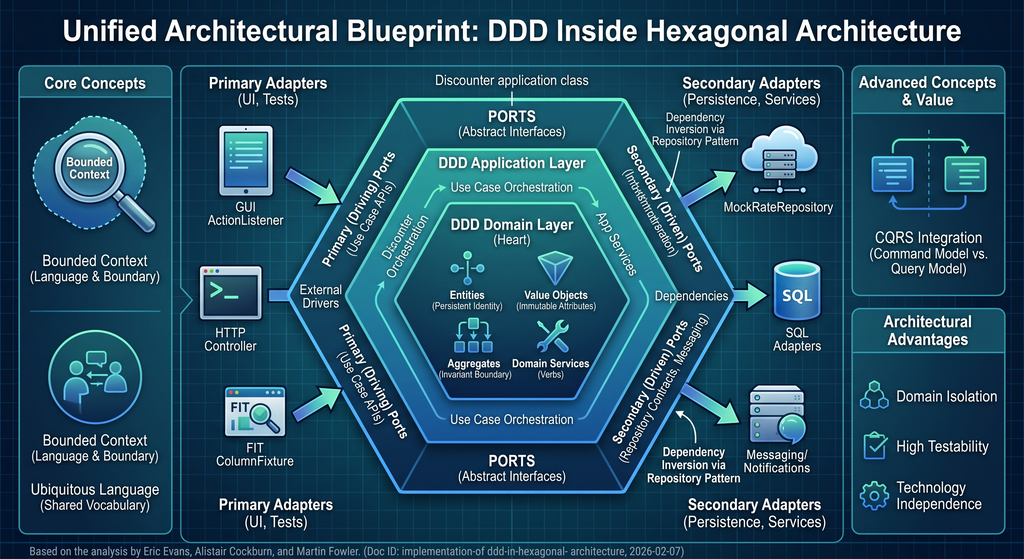
Hexagonal Architecture and Domain-Driven Design fit together seamlessly. Hexagonal Architecture defines the macro-structural boundary and decoupling strategy, while DDD dictates the micro-structural modeling discipline inside that boundary.
+-----------------------------------------------------------------------+
| OUTSIDE: Infrastructure & UI Adapters                                |
|   (REST Controllers, SQL Databases, GUI, Message Queues)              |
|                                                                       |
|   +---------------------------------------------------------------+   |
|   | BOUNDARY: Ports (Interfaces)                                  |   |
|   |   Primary Ports (Use Case APIs) | Secondary Ports (Repos)     |   |
|   |                                                               |   |
|   |   +-------------------------------------------------------+   |   |
|   |   | INSIDE: Application Core                              |   |   |
|   |   |                                                       |   |   |
|   |   |   +-----------------------------------------------+   |   |   |
|   |   |   | DDD Application Layer                         |   |   |   |
|   |   |   |   (Use Case Orchestration, App Services)      |   |   |   |
|   |   |   |                                               |   |   |   |
|   |   |   |   +---------------------------------------+   |   |   |   |
|   |   |   |   | DDD Domain Layer (Heart)              |   |   |   |   |
|   |   |   |   |   (Entities, Value Objects,           |   |   |   |   |
|   |   |   |   |    Aggregates, Domain Services)       |   |   |   |   |
|   |   |   |   +---------------------------------------+   |   |   |   |
|   |   |   +-----------------------------------------------+   |   |   |
|   |   +-------------------------------------------------------+   |   |
|   +---------------------------------------------------------------+   |
+-----------------------------------------------------------------------+- Center of the Hexagon (Inside)
Houses the DDD Domain Layer (Entities, Value Objects, Aggregates, Domain Services) enclosed by the DDD Application Layer (Application Services managing use cases). This core contains all business logic and remains completely free of technology-specific dependencies. - Hexagon Boundary (Ports)
Formed by abstract Java interfaces. Primary Ports map to Application Layer interface boundaries (defining available use cases). Secondary Ports map to domain abstractions, such as abstract Repository interfaces or messaging gateway contracts. - Outer Hexagon (Adapters)
Maps directly to the DDD Infrastructure Layer and UI Layer. Outer adapters implement the secondary port interfaces (e.g., an SQL repository adapter implementing a domain repository port) or invoke the primary port APIs (e.g., a REST HTTP controller executing an application use case).
The Repository Pattern as the Coupling Bridge
The Repository pattern acts as the architectural bridge between Hexagonal Architecture and DDD by exemplifying the Dependency Inversion Principle (as formulated by Robert C. Martin and analyzed by Martin Fowler).
Under Dependency Inversion, high-level domain modules must not depend on low-level infrastructure modules; both must depend on abstractions. This structural inversion prevents “framework lock-in,” guaranteeing that the enterprise can migrate persistent storage technologies (e.g., moving from an on-premise relational database to a cloud-native document store) without modifying business logic.
To make this architectural bridge concrete, consider the implementation artifacts based on Alistair Cockburn’s original reference code:
Secondary Port Interface
Resides INSIDE Application Core / Domain Layer.
package domain.ports;

public interface RateRepository {
    double getRate(double amount);
}
Secondary Adapter Implementation
Resides OUTSIDE in Infrastructure Layer.
package infrastructure.adapters;

import domain.ports.RateRepository;

public class MockRateRepository implements RateRepository {
    public double getRate(double amount) {
        if (amount <= 100.0) return 0.01;
        if (amount <= 1000.0) return 0.02;
        return 0.05;
    }
}
Application Core Class Using Constructor Injection
Resides INSIDE Application Core.
package domain.application;

import domain.ports.RateRepository;

public class Discounter {
    private final RateRepository rateRepository;

    // Dependency Inversion via Constructor Injection
    public Discounter(RateRepository rateRepository) {
        this.rateRepository = rateRepository;
    }

    public double discount(double amount) {
        double rate = rateRepository.getRate(amount);
        return amount * rate;
    }
}
Primary Adapter / Test Harness
Resides OUTSIDE in UI / Test Layer.
package testing.adapters;

import fit.ColumnFixture;
import domain.application.Discounter;
import infrastructure.adapters.MockRateRepository;

public class TestDiscounter extends ColumnFixture {
    private Discounter app = new Discounter(new MockRateRepository());
    public double amount;

    public double discount() {
        return app.discount(amount);
    }
}
Advanced Architectural Synergy: Integrating CQRS
Within highly complex Bounded Contexts, architects can integrate Command Query Responsibility Segregation (CQRS)—a pattern formulated by Greg Young and synthesized by Martin Fowler in 2011.
CQRS departs from the traditional CRUD mental model by splitting the application conceptual model into two distinct paths:
- Command Model
Handles state-changing operations, enforcing complex business rules, aggregates, and domain invariants. - Query Model
Handles data retrieval, optimized specifically for presentation, reporting, and high-throughput read operations.
                                  +-----------------------+
                                  |   HTTP Read Request   |
                                  +-----------+-----------+
                                              |
                                              v
                                  +-----------------------+
                                  |     Query Adapter     |
                                  +-----------+-----------+
                                              |
                                              v
                                  +-----------------------+
                                  |    Read-Optimized     |
                                  |     Query Model       |
                                  +-----------------------+
                                              ^
                                              | (Eventual Consistency)
+------------------------+        +-----------+-----------+
|  HTTP Command Request  |------->|    Command Adapter    |
+------------------------+        +-----------+-----------+
                                              |
                                              v
                                  +-----------------------+
                                  | Application Core Port |
                                  +-----------+-----------+
                                              |
                                              v
                                  +-----------------------+
                                  |   Domain Write Model  |
                                  |  (Aggregates/Entities)|
                                  +-----------------------+
There are somme engineering Trade-Offs & Implementation Friction in CQRS…
While CQRS aligns elegantly with Hexagonal Ports and Adapters, software architects must weigh significant operational trade-offs before introducing it:
- Eventual Consistency Lag
Splitting read and write models often requires asynchronous synchronization (e.g., domain events published to a message bus). The resulting propagation delay introduces eventual consistency, requiring UI adapters to handle transient out-of-sync states gracefully. - Dual Model Maintenance Overhead
Teams must maintain two separate object schemas and mapping pipelines, increasing initial development friction and operational complexity. - Indiscriminate Application Risks
As Martin Fowler explicitly warns, applying CQRS across simple CRUD contexts adds unwarranted risk and drag on productivity. CQRS should be restricted to demanding, high-throughput sections within specific Bounded Contexts.
Architectural Evaluation: Why This Cohabitation Delivers High Value
Combining Hexagonal Architecture and Domain-Driven Design delivers distinct structural benefits for enterprise software systems:
- Complete Domain Isolation
Core business rules inside the inner domain layer are fully protected from contamination by presentation frameworks, HTTP controllers, and persistence ORMs. - High Testability & Rapid Feedback
Applications can be executed and regression-tested in headless mode using fast, automated test harnesses (such as FIT or JUnit) and in-memory mock adapters, drastically reducing build execution time. - Clean Dependency Management & Governance
Enforces the Dependency Inversion Principle systematically. High-level domain logic dictates the contracts (Ports) that low-level infrastructure adapters fulfill, preventing framework lock-in and simplifying enterprise technology migrations. - Symmetric Technology Independence
External infrastructure components—such as relational databases, message brokers, or external web services—can be swapped out or upgraded over time with minimal impact on core business workflows.
Practical Implementation Friction & Boundary Overhead can be mitigated by the architects remaining mindful of the technical friction introduced by strict boundary isolation:
- Object Mapping Overhead
Translating database persistence DTOs/ORM entities into pure, framework-agnostic Domain Entities at the Secondary Adapter boundary adds computational and memory mapping overhead. Architects must evaluate high-performance mapping frameworks or manual mapping strategies to avoid throughput bottlenecks in data-intensive systems. - Interface Proliferation
Enforcing abstract ports for every external interaction increases the total class count and indirect procedure calls within the solution structure.
Conclusion & Executive Summary for Architects
Hexagonal Architecture and Domain-Driven Design address two sides of the same enterprise software challenge.
Hexagonal Architecture establishes the outer structural boundary and decoupling strategy, organizing system interactions symmetrically around abstract ports and adapters to isolate the application core.
Domain-Driven Design provides the inner modeling discipline and linguistic clarity, structuring complex domain knowledge into explicit Bounded Contexts, Ubiquitous Language, Aggregates, Entities, Value Objects, and Services.
The architect’s Rules of Thumb for implementing Hexagonal Architecture and DDD together are:
- Define Use Cases at the Application Boundary
Specify primary port interfaces directly against the inner application boundary rather than coupling use cases to specific UI wireframes or database schemas. - Establish a Ubiquitous Language First
Ensure developers and domain experts share a single, explicit vocabulary within each Bounded Context, and mirror that vocabulary directly inside the codebase. - Invert Infrastructure Dependencies
Always place Repository interfaces inside the domain layer (Ports) and place technical persistence logic outside in the infrastructure layer (Adapters). - Enforce Aggregate Invariants & Value Object Immutability
Protect state transitions by routing modifications through Aggregate Roots, and model descriptive concepts without identity as immutable Value Objects. - Manage Domain Association Multiplicity
Restrict domain associations to unidirectional traversal paths, use qualifiers to eliminate N-to-M associations, and prune non-essential references. - Apply Advanced Patterns Selectively
Avoid applying complex patterns like CQRS indiscriminately across an entire enterprise suite; restrict them to high-throughput or highly complex domain models within designated Bounded Contexts.
Code in action
Here is an example implementation of the DDD and hexagonal architecture in a standard Go project as described in this article.