Evolution of Chinese Hashrate in Bitcoin Mining
Here is an overview of the evolution of Bitcoin hashrate coming from (or attributed to) China — in particular its share of the network’s total hashrate — as well as recent facts showing how this dynamic has changed since 2021.
Before 2021
Before July 2021, China was largely the leading country for Bitcoin mining, with more than 60% to ~65% of the global hashrate. Large mining farms and manufacturers (like Bitmain) were based there. (Bitbo)
Total Ban in 2021
In July 2021, the Chinese government banned Bitcoin mining across the entire territory, forcing farms to shut down or migrate abroad (mainly USA, Kazakhstan, Russia). (Bitbo); China’s active contribution to the hashrate fell practically to zero at the declared international level. (Bitbo)
Global Migration between 2022 and 2024
- Following the ban, the “official” Chinese hashrate drops drastically.
- According to some Cambridge/Bitbo estimates, after the migration:
- 2022: China’s estimated share drops back to around ~21% (through indirect activities or China-linked pools). (Bitbo)
- Other reports suggest that pools managed by Chinese actors still controlled a large portion of the hashrate despite local policy (e.g., some pools in September 2024 reported ~55% of global hashrate attributed to China-linked entities).(Cointelegraph)
These figures vary greatly depending on methodology — some measure the location of farms, others the geographical origin of pools, which is not always the same thing.
China’s Return to Mining in 2025
Recent data shows that:
Late October / November 2025
China’s share of Bitcoin’s global hashrate has risen back to approximately 14% despite the official ban remaining in place. (CoinDesk) This resurgence is explained by underground or semi-official operations using cheap electricity and underutilized data centers, particularly in energy-rich provinces like Xinjiang or Sichuan. (EthNews)
Additional Data
Reuters also notes that in November 2025, China had regained around 14% of global hashrate at the end of October. (Reuters) Some experts indicate that the real figure could be between ~15% and 20%, taking into account activities that are difficult to measure. (Reuters)
Timeline Summary of Evolution
| Period | Estimated China-linked hashrate share |
|---|---|
| Before 2021 | > 60% (global leader) (Bitbo) |
| 2021 (after ban) | ~0% (official mining closed) (Bitbo) |
| 2022 | ~21% (some indicators) (Bitbo) |
| 2024 | divergent reports up to ~55% depending on methodologies (Cointelegraph) |
| End of 2025 | ~14% (significant return) (CoinDesk) |
Key Takeaways
- The strict 2021 policy temporarily reduced to almost zero official mining activity in China. (Bitbo)
- Despite this, clandestine activity continued or gradually resumed, which is reflected today in a significant share (~14%) of global hashrate. (CoinDesk)
- Differences between sources show that these estimates remain approximate and depend on methodology (actual mining on territory vs. origin of pools).
Here is a chart (based on published “benchmark” points) of the Bitcoin hashrate share attributed to China (as % of global hashrate), plus the data file.
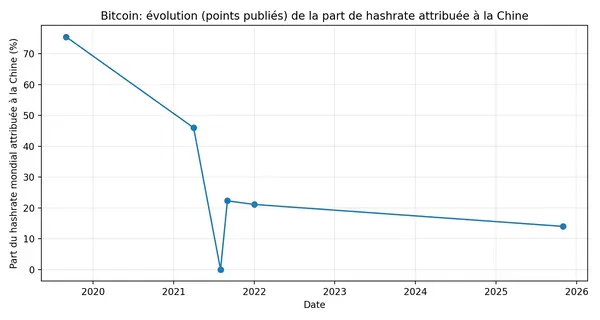
- In September 2019: 75.5% (Cambridge Judge Business School)
- In April 2021: 46% (Cambridge Judge Business School)
- July–August 2021: “effectively at zero” (following the ban) (Cambridge Judge Business School)
- September 2021: 22.29% (Cambridge Judge Business School)
- January 2022: 21.11% (Cambridge Judge Business School)
- End of October 2025: 14% (Hashrate Index / Reuters) (Reuters)
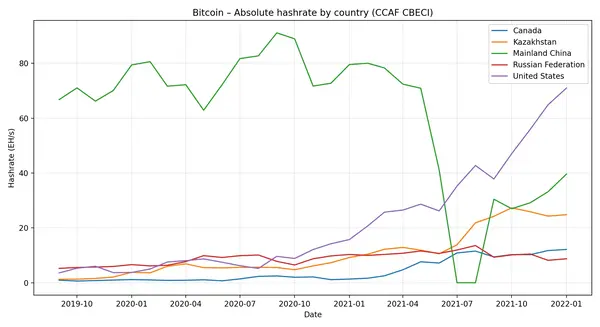
These figures depend on IP geolocation / pools methodology and may be biased (VPN/proxy), which Cambridge also emphasizes. ([ccaf.io][9]).
It is no secret within the industry that hashers in certain locations use virtual private networks (VPNs) or proxy services to mask their IP addresses in order to conceal their location. Such behaviour can skew the sample and result in an over-estimation (or under-estimation) of the hashrate in certain provinces or countries. Following the government ban in June 2021, the reported hashrate for mainland China effectively dropped to zero during the months of July and August, but suddenly rebounded to more than 20% in September. This strongly suggests that significant underground mining activity has formed in the country, which appears to empirically confirm similar claims from major industry players and miners.
This article is generated by artificial intelligence (AI) and may not be manually reviewed. The content displayed above does not represent the views of piprime.fr. Similarly, piprime.fr does not endorse the accuracy or truthfulness of the above data. Under no circumstance should reliance be placed on the above information.