NFT Fundamentals and Applications
This article is also available in French.
This is the summary of a MOOC course Mastering Web3 provided by Université de Nicosia.
NFTs and Ethereum Standards
Ethereum is a Multitoken Network
Like Bitcoin, Ethereum features its own native currency/token, called Ether. Ether is the second largest cryptocurrency by market capitalization today.
However, Ethereum can also support the creation of additional tokens:
- Some of these additional tokens are fungible, while others are not (non-fungible tokens – NFTs)
- Fungible tokens (of the same type) are interchangeable. In other words, a unit of a fungible token is of equal value to any other token of the same type
- Non-fungible tokens (NFTs) are not generally interchangeable at the same value. In other words, one Cryptopunk may have significantly different market value from other tokens in the same collection (i.e., other Cryptopunks)
Ethereum tokens are governed by ERC standards
- ERC-20: Fungible Token Standard (2015)
The most widely used standard for fungible tokens on the Ethereum blockchain. - ERC-721: Non-Fungible Token Standard (2018)
The most widely used standard for NFTs on the Ethereum blockchain. - ERC-1155: Multi Token Standard (2018)
A standard interface for smart contracts that manage multiple token types. A single smart contract may include any combination of fungible tokens, non-fungible tokens, or other configurations (e.g., semi-fungible tokens). - ERC-6551: Token Bound Accounts (2023)
A new standard that allows NFTs to have their own wallets.
ERC-721 is Ethereum’s most popular NFT standard
ERC-721 allows for the implementation of a standard API for NFTs within Ethereum smart contracts. The standard provides basic functionality to track and transfer NFTs.
ERC-721 tokens are created by writing code in a smart contract programming language, like
Solidity.
In practice, most NFT collections today will be created through service providers and will
require little or even no programming to create the token.
ERC-1155 is Ethereum’s multi-token standard
ERC-1155 implements a standard interface for contracts that manage multiple token types:
- ERC-20 requires deployment of separate contracts per token type.
- ERC-721 groups a collection of non-fungible tokens in a single contract, with settings for the entire collection.
- ERC-1155 allows for each token ID within a collection to represent a new configurable token type, which may have its own metadata, supply and other attributes.
The innovation of ERC-1155 is that multiple tokens can co-exist in the same smart contract.
New functionalities are possible, such as transferring multiple token types at once, thus saving on transaction costs.
Such functionality is particularly helpful, for example, in gaming applications, which may combine
fungible and non-fungible items (e.g., currency and swords)
Despite its flexibility, ERC-1155 is currently less popular than ERC-721. This is likely due to the increased complexity of implementing and maintaining an ERC-1155 contract compared to an ERC-721 contract. However, ERC-1155 is gaining popularity as more developers and projects adopt it for its advanced features and potential use cases..
ERC-6551
ERC-6551 will provide the ability for NFTs to have their own wallet.
- This will allow NFTs to have a trading history, a collection, and an identity.
- It can be thought of as the inverse of soulbound tokens (SBTs), where the NFT is permanently tied to an account/wallet.
- In practice ERC-6551 gives every ERC-721 token a smart contract account.
- Possible applications based on ERC-6551:
- Combination with Artificial Intelligence (AI): An automated investment portfolio composed of multiple non-fungible assets.
- Facilitating airdrops directly to NFTs: Gaming characters will be able to own their own items.
- Facilitating direct payments to NFTs: Users can pay directly to an NFT, which can then be used to purchase other NFTs or services.
Sources: [https://eips.ethereum.org/EIPS/eip-6551], [https://cointelegraph.com/explained/the-erc-6551-token-standard-explained].
Different standards for different applications:
| ERC-721 | ERC-1155 | ERC-6551 | |
|---|---|---|---|
| Scope | Tokenize unique individual assets. | Combine multiple token types. | Enable wallet/accounts for NFTs. |
| Fungibility | NFT only. | FT & NFT. | NFT with smart contract capabilities. |
| Application focus | Collectibles, art, digital assets, tokenized real-world assets. | Gaming, other applications involving multiple assets. | Composability, identity, provenance, dependency. |
| Advantages | Standardizes how unique assets are securely stored and managed on the blockchain. | Saves on computational burden by reducing the approval steps needed to transfer multiple tokens in a single transaction. | Enhances the functionality and value of NFTs. Compatible with existing ERC-721 tokens. |
| Disadvantages | Tokens are indivisible. NFTs cannot be combined with fungible tokens. | The standard is not backward compatible, so it cannot handle ERC-20 or ERC-721 implementations. | Requires a permissionless registry to create and manage token bound accounts |
| Gas consumption | Slightly lower than ERC-20. | Lower for transactions involving multiple token types in a batch transfer. | Moderate. Deploying a proxy contract requires a small fee. |
Source:
- Adapted from Security Tokens — An ERC-Standards Comparison.
- What Is ERC-6551? Explaining the New NFT Token Standard.
The Anatomy of NFT
What is an NFT?
An NFT is a unique digital asset that is stored on a blockchain. It represents ownership of a digital item, such as a piece of art, a collectible, or a virtual item in a game. Each NFT is unique and has its own unique identifier, which is stored on the blockchain. This identifier is used to verify the ownership of the NFT and to track its history.
The adoption pathway of NFTs
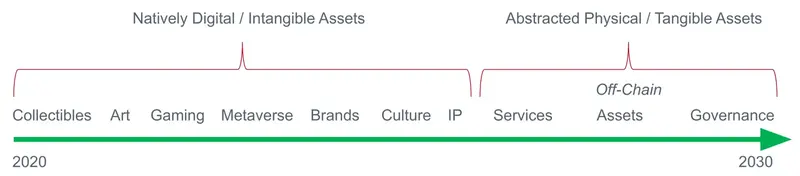
- More than $75 trillion existing stock of intangibles.
- The only “public commons” open database for the metaverse.
- Physical world assets & services.
- Needs regulatory bridges so will take some time.
A mental model
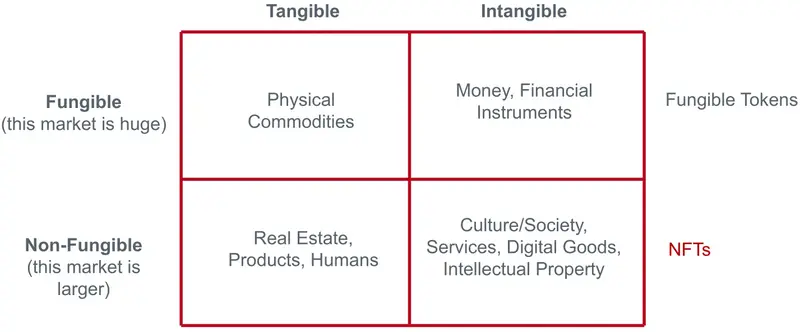
Breaking down the components
In most cases, due to the expense of storing data on a blockchain, the image of the NFT is not
blockchain. Instead, just a “pointer” to the image is stored on the blockchain.
The image is stored in a centralized storage or in de decralized storage.
Examples of decentralized storage networks
IPFS and Arweave are examples of decentralized storage networks.
- IPFS (InterPlanetary File System)
- Distributed storage protocol that allows the storage and distribution of uniquely identifiable files as part of a global peer-to-peer network.
- Every computer in the world can choose to “pin” (host) and distribute any files they choose via downloading the IPFS software.
- Arweave
- A distributed storage protocol with a different design philosophy.
- The hosts are paid upfront for permanent storage under the theory that the cost of storage will drop fast enough over time to allow the upfront payment to cover the storage costs forever.
In the NFT field, both IPFS and Arweave are considered adequate solutions for decentralized storage versus centralized servers.
Examples of centralized storage networks
Amazon S3 and Google Cloud Storage are examples of centralized storage networks.
On-chain storage: Natively on-chain
On-chain storage refers to the actual saving of the asset on the blockchain itself. Projects that store all asset files on-chain are called natively on-chain, as all the information associated with an NFT is stored on the blockchain (metadata and the actual asset).
Saving the asset on-chain preserves all the first order features of the blockchain:
- Immutable
- Decentralized
- No single-point of failure, etc.
This is only feasible / cost-effective for artwork that can be described in code.
In other words, this could be a design choice in generative art, but it might be economically/technically infeasible for photography or videography
Here some examples of natively on-chain projects:
- Web3.storage Bounty
- Filecoin
| Solution | Fully On-Chain | Permanent | Cost | Common Use |
|---|---|---|---|---|
| Ethereum storage | ✅ | ✅ | 🔥🔥🔥 | Small data |
| Bitcoin OP_RETURN | ✅ | ✅ | 🔥 | Tiny data |
| Arweave | ⚠️ (own chain) | ✅ | 💰 | NFTs, media |
| IPFS | ❌ | ❌ | 💸 | NFT pointers |
| Filecoin | ❌ | Depends | 💸 | Long-term storage |
| Celestia | ❌ | ❌ | 💸 | Rollups |
| Ordinals | ✅ | ✅ | 🔥🔥🔥 | NFTs |
NFTs In Art
NFTs in art are a type of NFT that is used to represent a piece of art. These projects are often created by artists and collectors, and they can be bought and sold on secondary marketplaces. NFTs in art are often used as a way to showcase an artist’s work and to build a community around their brand.
Profile Picture Projects (PFP)
Profile Picture Projects (PFP) are a type of NFT that is used as a profile picture on social media platforms. These projects are often created by artists and collectors, and they can be bought and sold on secondary marketplaces. PFPs are often used as a way to showcase an artist’s work and to build a community around their brand.
Art NFTs
Art NFTs are a type of NFT that is used to represent a piece of art. These projects are often created by artists and collectors, and they can be bought and sold on secondary marketplaces. Art NFTs are often used as a way to showcase an artist’s work and to build a community around their brand.
Profile Picture Projects (PFP) and Art NFTs Dominate the Market
PFP collections are still dominating the market cap followed by Art:
- PFPs ~71.43% dominance (Ξ2M)
- Art ~20.48% (Ξ573.3K)
- Remaining categories: ~7.94% (Ξ222.4K)
PFPs and Art NFTs are the most popular types of NFTs in the market, with a combined market cap of ~91.91% (Ξ2.77M). The remaining categories, such as music, sports, and gaming, have a combined market cap of ~8.09% (Ξ249.6K).
The webApp NFT Valuations permits to estimate the value of an NFT based on its rarity and popularity.
The Multifaceted Nature of Profile Pictures (PFPs)
Variability in PFP Usage
Research indicates individuals employ 3 to 5 distinct PFPs across diverse platforms and networks.
Platform Perception & Identity Projection
Users’ online self-representations are influenced by their understanding of a platform’s ethos and its perceived audience.
Audience-Driven Identity Curation
Users strategically curate their online depictions based on their perceptions of the predominant audience’s preferences and expectations.
PFP as a Symbolic Identity Marker
Each PFP acts as a visual emblem, mirroring the specific facet of online identity it embodies.
Types of Online Identities Reflected in PFPs
- Community Identity: PFPs resonate with a community’s collective ethos and values
- Avocational Identity: PFPs mirror individual passions, hobbies, and interests
- Professional Identity: On career-oriented platforms, PFPs often portray individuals in a professional manner that emphasizes professionalism and reliability
PFPs are about identity
PFPs are about identity, reflecting the multifaceted nature of online self-representation. They serve as visual symbols that encapsulate various aspects of an individual’s online persona, including community affiliation, avocational interests, and professional aspirations. By strategically curating their PFPs, users project a curated image that aligns with their perceptions of the predominant audience’s preferences and expectations.
Avatar/PFP Effects are Likely to be Bilateral
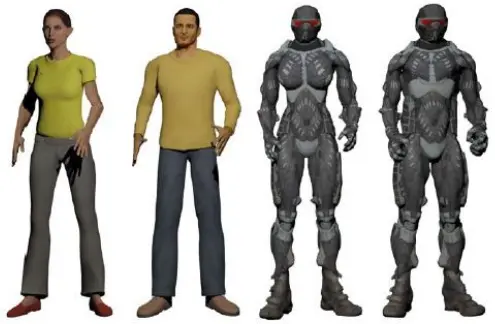
Research conducted at the University of Nicosia revealed intriguing findings into the impact of virtual avatars on user’s physical attributes.
It was discovered that individuals whose avatars embodied “stronger” characteristics demonstrated measurable improvements in physical strength during various tests. This suggests that the perception and representation of one’s avatar can influence their real-world physical capabilities.
Moreover, researchers found that visual elements alone proved to be more effective in predicting personality traits in comparison to text features or a combination of both.
A single profile picture emerged as a reliable indicator to predict a user’s personality, representation in shaping online impressions people form of others in online environments, and the potential impact of PFPs on user behavior and engagement.
Sources:
- Aliens versus humans: Do avatars make a difference in how we play the game?
- Automatic personality prediction using deep learning based on social media profile pictures and posts.
CryptoPunks emerged as generative collectables
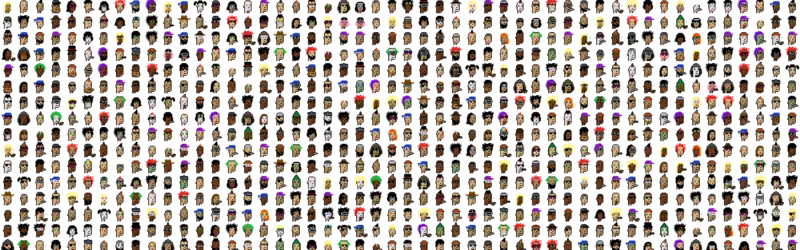
CryptoPunks represent a collection of 10,000 NFT randomly generated collectible characters based on distinct traits. Their ownership is securely stored on the Ethereum Blockchain.
They were originally offered for free to claim in June 2017. Today, they have evolved into highly
sought-after digital assets with their prices ranging from thousands of US dollars to millions for the most rare ones.
Larva Labs, the creator of CryptoPunks introduced a groundbreaking concept by embedding the
first collection built-in decentralised marketplace, which included royalty free trading.
Larva Labs maintained 10% of the supply as well as the IP and copyright of the whole collection.
Launched in June 2017, CryptoPunks is a pioneering interactive art project on the Ethereum blockchain: 10,000 unique, 24×24 pixel characters - humans, apes, zombies, and aliens - algorithmically generated and permanently inscribed on the blockchain. What began as an experiment in digital ownership became the catalyst for a modern art movement, the prototype for NFTs as we know them, and a cultural phenomenon that continues to ripple outward.
– Matt Hall and John Watkinson
In 2022, the project’s intellectual property was acquired by Yuga Labs, and in 2025, it passed to the digital art nonprofit Infinite Node Foundation, ensuring the collection and community’s long-term continuity and preservation. The Punks themselves remain forever unchanged: 10,000 portraits living permanently on the blockchain, enduring as art, code, and culture.
Source: CryptoPunks
And Evolved to be Much More…
CryptoPunks embody a combination of different elements:
- Digital Art
They are digital artworks with distinct and creative pixel art designs, each with its own unique characteristics. - Collectibles They function as a built-in marketplace and have become highly sought-after collectibles in the crypto world.
- PFP/ Community Many users adopt CryptoPunks as their online avatars, establishing a sense of identity and belonging within the community.
- Social Media CryptoPunks have become a popular subject for social media posts, with users sharing their favorite Punks and engaging with the community on platforms like Twitter and Instagram.
Bored Ape Yacht Club
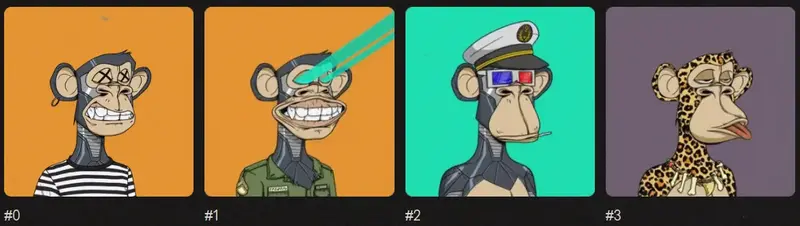
Launched in April 2021 on the Ethereum blockchain, Bored Ape Yacht Club (BAYC) is a collection of 10,000 unique NFTs representing randomly generated collectible characters. Created by Yuga Labs, BAYC introduced utility to NFTs by offering exclusive benefits to its members, such as access to exclusive events, merchandise, and partnerships with brands and creators. The collection has become a symbol of the NFT space, elevating it by adding real-world applicability and establishing a new standard for NFTs as exclusive “membership cards” granting real-world benefits.
Source: boredapeyachtclub.com
Introducing Utility to NFTs
Yuga Labs heavily emphasized on providing utility to NFTs, enhancing their value and utility beyond just being digital collectibles:
- Membership includes entry to a virtual meeting space, fostering networking and community engagement;
- Token ownership grants certain commercial rights, enabling monetization opportunities;
- Access to in-person gatherings, such as VIP parties;
- Periodic airdrops offer additional value and rewards, enhancing long-term token holder benefits;
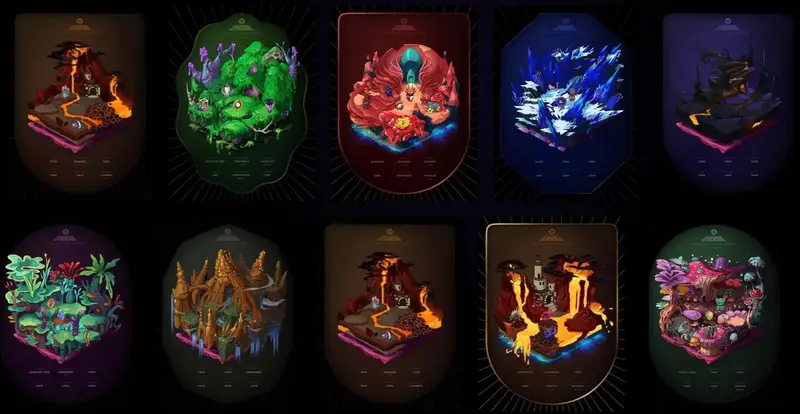
- Inclusion in Otherside, a digital universe, offers interactive and immersive user engagement;
- Exclusive access to exclusive events, merchandise, and partnerships with brands and creators.
Source: OTHERSIDE
NFT Creation Mechanics
The process of creating a new NFT
- Idea Conception;
- Digital Creation and Design;
- Tokenisation;
- Metadata and Attributes Creation;
- Smart Contract Configuration;
- Listing on a Marketplace;
- Sale and transfer.
Step 1 - Idea Conception
- Identify the Asset
Determine the kind of digital item you want to mint, whether it’s an art piece, a musical composition, a video clip, or something else entirely - Figure out its Value Proposition
- Assess what makes your asset special
- Is it a one-of-a-kind piece?
- Does it belong to a limited edition?
- What is its intrinsic or perceived value?
- CryptoPunks offers 10.000 limited-edition, algorithmically generated avatars that are stored on the Ethereum blockchain, providing provable ownership and scarcity
- Assess what makes your asset special
Step 2 - Digital Creation
- Design the Asset
Now that you know what you are creating and why it is valuable, proceed to design or craft your digital piece that will eventually be minted as an NFT. - Ensure its Originality and Compliance
Be sure your creation is unique to avoid copyright issues. Also, ensure you have the legal right to mint the asset.
Step 3 - Tokenization
- Choose a Blockchain
Popular blockchains for minting NFTs include Ethereum, Binance Smart Chain, and Polygon. Your choice may depend on various factors such as network fees, popularity, and supported standards. - Utilize NFT Standards
Select an NFT standard that fits your needs. ERC-721 is commonly used for unique assets, while ERC-1155 allows for both fungible and non-fungible tokens in a single contract. - Mint the NFT
Finalize the creation process by “minting,” or converting your digital asset into a non-fungible token.
This action is usually done through a platform interface and commits your asset and its metadata to the blockchain.
Step 4 - Metadata and Attributes
- Define the NFT Metadata
Input key information to identify and describe your NFT
This includes the title for easy recognition, a descriptive summary to capture its essence, the creator’s name for attribution, and various attributes (like colour, edition number, or genre) that provide more context. - Embed Special Properties
Go beyond basic information by adding unique features or traits
This could be unlockable content, limited-edition labels, or even interactive elements that deepen engagement and potentially add to the NFT’s value. - Enhance Interactivity
Make your NFT more engaging by incorporating interactive elements.
For example, you could create an NFT that changes its appearance based on user interaction or triggers a specific action when scanned.
Step 5 - Smart Contracts Configuration
- Set up a Smart Contract
Create a blockchain-based smart contract that acts as the legal and functional backbone for your NFT. This contract enforces how the NFT can be used, sold, or transferred. - Define your Rules
Within the smart contract, outline specific provisions for how ownership is handled, the percentage of royalties that go to the original creator upon resale, and the conditions under which the NFT can be transferred or interacted with.
Step 6 - Listing on a Marketplace
- Select a Marketplace
Choose where to list the NFT (e.g., Blur, OpenSea, Rarible, SuperRare, etc.,) - Upload and Set Metadata
Verify the set metadata (title, description, creator, attributes) - Set Pricing Parameters
Set a specific price for the NFT - Review and Confirm
Before publishing, double-check all details to ensure accuracy and completeness - Publish the NFT
Once satisfied, publish your NFT on the marketplace, making it available to potential buyers
Step 7 - Sale and Transfer
- Monitor Bids
Regularly check the bidding activity on your NFT. Keep an eye out for incoming offers and evaluate them based on your set criteria for selling the asset. - Complete the NFT Sale
Accept a bid or reach the auction deadline, then transfer NFT ownership to the buyer. Collect your funds in the chosen cryptocurrency. - Monitor Sales and Performance
Keep track of sales data and performance metrics to understand your NFT’s popularity and value over time.
Batch creation of NFTs
Here are solid, widely-used ways to batch-create (mint) NFTs via APIs, grouped by what you’re trying to optimize for:
Turnkey “Minting API” providers (fastest to ship)
- NFTPort (ERC-1155 batch mint via API) – has a dedicated batch customizable minting endpoint for ERC-1155 “product” contracts, letting you mint multiple tokens in one call (and multiple copies per token). (docs.nftport.xyz)
- Crossmint Mint API (custodial / walletless options) – mint & deliver NFTs to a wallet or even an email address (they can create a wallet for the user). Available as a REST API and also via a QuickNode Marketplace integration. (docs.crossmint.com)
- Venly NFT API (batch distribute to many recipients) – designed for batch mint + send to multiple wallet addresses (optionally different amounts per destination). (Venly)
- Immutable Minting API (batch + async processing) – supports batch minting and processes requests asynchronously; batches may be optimized to share tx hashes to reduce costs. (docs.immutable.com)
Developer platforms (you still own the contract, but SDKs help a lot)
- thirdweb (batch metadata / batch mint patterns) – provides contract extensions like BatchMintMetadata (helpful for “batch” style drops where metadata is organized under a baseURI/tokenId pattern). Great if you want an SDK + contracts + dashboards. (thirdweb docs)
Storage + “roll your own minting API” (most control, common in production)
These don’t mint NFTs by themselves, but they’re usually part of any batch-mint pipeline:
- Pinata (IPFS uploads via API/SDK) – reliable way to batch-upload images + metadata to IPFS, then your backend mints in batches using your contract. (docs.pinata.cloud)
- OpenZeppelin contracts (build your own batch mint functions) – standard, audited base contracts; you implement batch minting patterns (often ERC-1155 for true batching, or gas-optimized ERC-721 approaches). (OpenZeppelin Docs)
Chain-specific batch minting
- XRPL (batch mint example) – if you’re on XRP Ledger, there’s a documented JS flow for batch minting multiple NFTs. (xrpl.org)
Note on “NFT APIs” that are mostly for data (not minting)
- Alchemy NFT API and Moralis NFT API are excellent for indexing, querying, metadata, ownership, etc., but they’re not primarily “minting-as-a-service” batch mint APIs in the same way as NFTPort/Crossmint/Venly/Immutable. (Alchemy)
Top 3 batch NFT minting API solutions on Ethereum (EVM)
- NFTPort (ERC-1155 batch mint via REST API)
- Best when you want “true” batching (multiple tokens / quantities in one call) using ERC-1155.
- Has a dedicated Batch customizable minting (ERC1155) endpoint: “create multiple NFTs with one API call” and “more than one of the same token.” (docs.nftport.xyz)
- Venly NFT API (batch mint + distribute to many wallets)
Best for airdrop-style batches where you mint and send to multiple destination addresses (even different amounts per wallet) in one request. (Venly) - Crossmint Minting API (mint + delivery, incl. walletless/email recipients)
Best when you need easy minting + delivery with fewer web3 UX headaches (e.g., recipients via wallet address or email, wallet creation via API). (docs.crossmint.com)
Conclusion
- NFTs represent unique digital assets on blockchains, enabling ownership of both digital and physical assets.
- Ethereum serves as a foundational platform for NFTs, supporting standards like ERC-721, with other blockchains such as Binance Smart Chain and Solana also contributing.
- PFPs serve as virtual identities within online communities, where their impact is shaped by quality, innovation, and community engagement.
- The future success of NFTs hinges on originality, utility, and seamless integration into diverse industries.
Further reading
- Exploring The Blur Marketplace + Minting an NFT Collection on OpenSea
- How Non-Fungible Tokens Work
- What are NFT profile pictures and why do people use them?
- What Is Tokenized Real Estate?
- PFP NFTs: A Beginner’s Guide
- NFT PFPs: The Rise of NFT Profile Pictures on Social Media